
Normal Breathing Rate and How to Track It
Have you ever wondered if you’re breathing too fast, slow, or just right? You can measure your respiratory rate – how fast or slow you breathe – in 3 steps. Let’s explore the normal respiratory rates for kids, babies, and adults. Then, track your breathing on a handy worksheet.
All about your respiratory rate
Your respiratory rate is the number of times you breathe in one minute.
Each time you breathe in, your lungs fill with air and fresh oxygen.
Each time you breathe out, your lungs deflate and release carbon dioxide.
Normal breathing rate for babies, kids, teens, and adults
Scientists have noticed that normal respiratory rates change at different ages.
What’s normal is also different when kids are resting compared to when they are busy playing and exercising.
Here are typical breathing rates for babies, children, teenagers, and adults at rest.
Why do babies breathe faster than adults?
Just like heart rates, babies have the fastest respiratory rates. Since their lungs are small, there’s less space to exchange oxygen and carbon dioxide.
As kids grow up and become adults, their breathing rate slows. By the teenage years, the normal respiratory rate is within the same range as adults. This is because the body becomes more adult-like after puberty.
How to check your respiratory rate in 3 steps
You can check your breathing rate at home, school, during sports games, or anywhere!
All you need is a stopwatch, a timer, or a clock with a second hand.
Sometimes, people lose track of the number when they count for longer. But counting the respiratory rate for 60 seconds is best when people are sick. That’s because the number is more accurate when you count longer.
When counting breaths, do you count in and out separately?
Each up-and-down chest movement is one breath cycle. In other words, one inhale plus one exhale equals one breath.
1 inhale + 1 exhale = 1 breath
Why does your respiratory rate change throughout the day?
Depending on whether your body needs more oxygen-rich blood flow, your breathing rate will speed up and slow down.
When your organs are more active and need more oxygen, your lungs will rev up in response.
What speeds up your breathing rate?
When you exercise, you breathe faster to keep up with your activity level.
Your breathing also speeds up when you’re scared, excited, or nervous. During active or stressful events, many people feel like they are panting.
Run around for 1 minute and check your respiratory rate. What number did you get this time?
What slows down your breathing rate?
When you rest and sleep, your breathing slows. You also breathe more slowly when you feel calm and relaxed. For example, mindfulness activities can slow down your breathing rate.
Lie down on a couch and rest for 5 minutes. Then, measure your respiratory rate again. What number did you get this time?
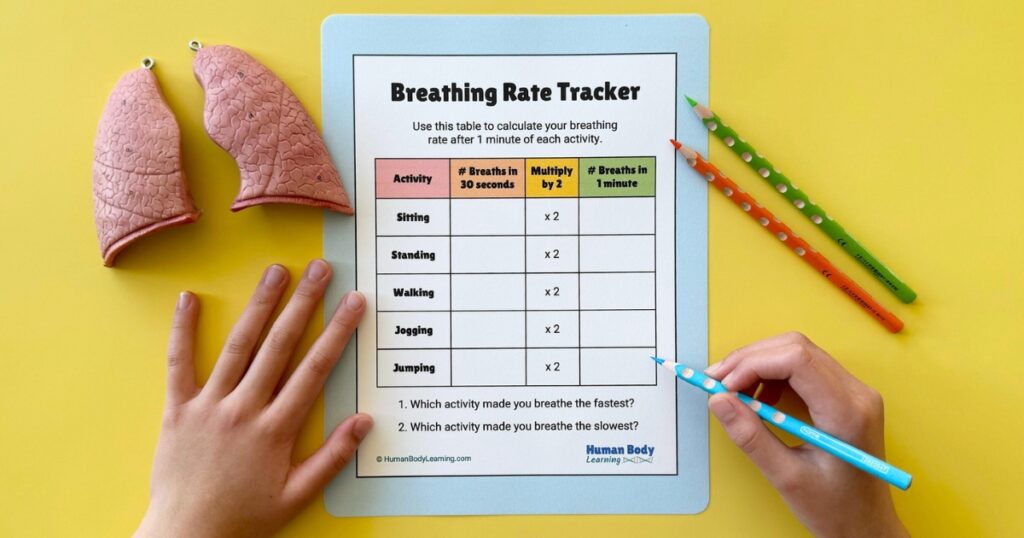
Breathing rate worksheet

Explore your respiratory rate at rest and after walking, jogging, and jumping! Track your results on this breathing rate worksheet.
Ask a friend or relative for permission to check their respiratory rate. How does it compare to yours?
More fun anatomy facts and activities!

DISCOVER: Fun Facts About Your Heart
LEARN: How to Check Your Pulse
Published on December 31, 2023. Updated on November 20, 2025 by Betty Choi, MD
Published on December 31, 2023. Updated on November 20, 2025 by Betty Choi, MD

Betty Choi, MD
Dr. Betty Choi is a Harvard-trained pediatrician who makes learning fun and doable. She created the kids’ anatomy book Human Body Learning Lab, which Science Magazine recommends as a “notable standout in the genre.”